Mechanical Ventilation Requirements: Understanding the 2018, 2021 & 2024 IECC
As homes become tighter and more energy efficient, mechanical ventilation has become an increasingly important part of residential construction. Unfortunately, it's also one of the most misunderstood portions of the energy code.
Builders often hear different answers depending on the city they are working in. One jurisdiction requires airflow testing. Another asks for a ventilation form. A neighboring city seems to have completely different requirements.
So which one is right?
The answer depends on three things:
The energy code adopted by the jurisdiction
Local amendments to that code
The documentation required by the building department
Understanding these requirements during the planning phase can help avoid delays and prevent surprises during final inspection.
Why Mechanical Ventilation Matters
Today's homes are significantly tighter than homes built just twenty years ago.
That is a good thing for energy efficiency, but tighter homes also reduce the amount of outside air that naturally enters the building through cracks and openings.
Without planned ventilation, pollutants, moisture, and stale air can accumulate inside the home.
Mechanical ventilation provides controlled fresh air while maintaining the home's energy performance and indoor air quality.
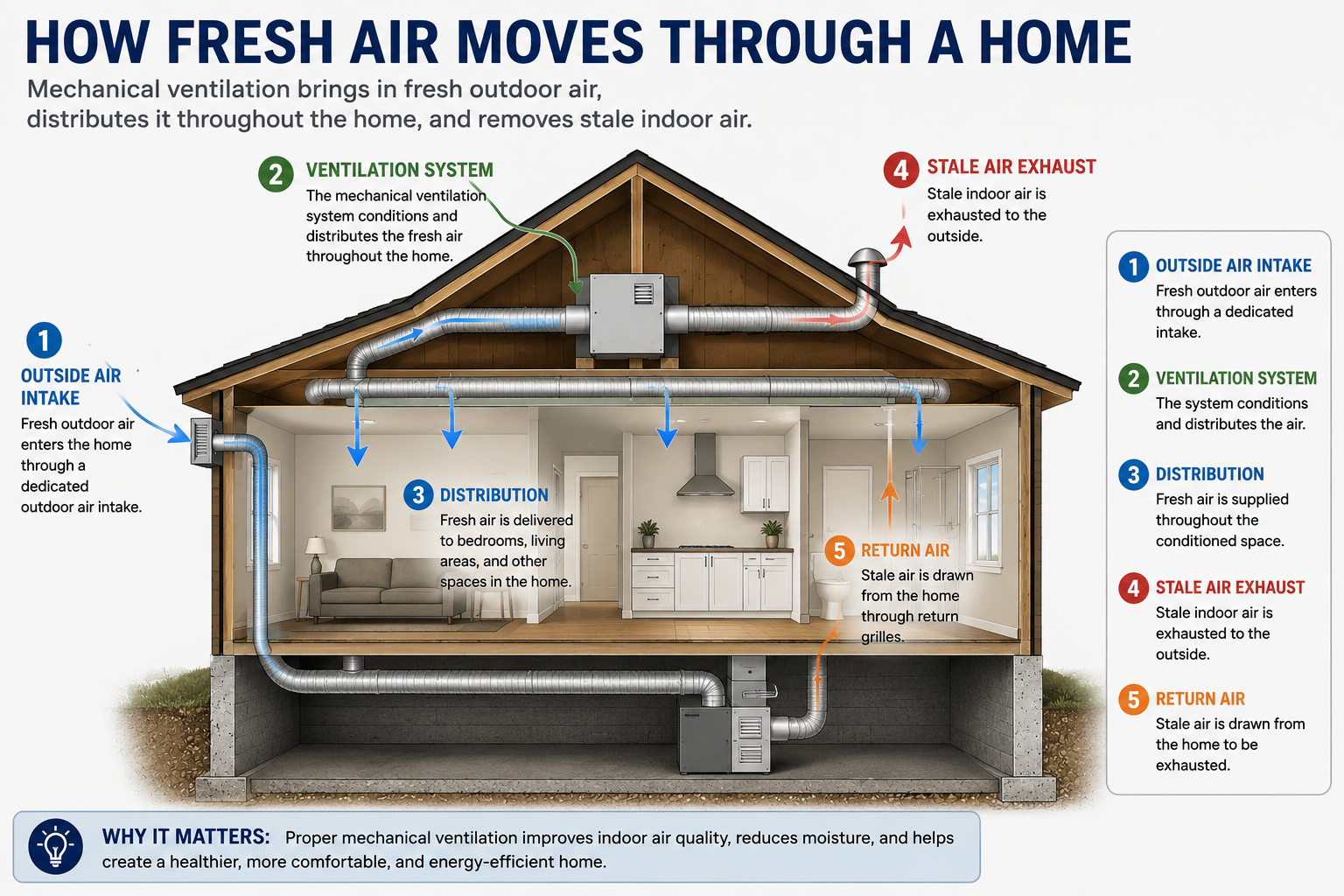
How Fresh Air Moves Through a Home
Mechanical Ventilation vs. Fresh Air Intake
One of the biggest misconceptions we encounter is that a fresh air intake and a mechanical ventilation system are the same thing.
While they often work together, they are not the same.
Fresh Air Intake
A fresh air intake simply provides a pathway for outside air to enter the home.
Examples include:
Outdoor air duct connected to the HVAC return
Outdoor air duct connected to a ventilation appliance
Other approved methods of introducing outside air
A fresh air intake alone does not guarantee the home is receiving the required amount of ventilation.
Mechanical Ventilation System
The mechanical ventilation system is the equipment and controls that intentionally deliver outdoor air into the home, remove stale indoor air, or both.
Examples include:
Supply ventilation
Exhaust ventilation
Balanced ventilation
ERVs
HRVs
The system must be properly designed, installed, and operated to meet the ventilation requirements of the adopted code.
Why the Difference Matters
Think of it this way:
A fresh air intake is the pathway.
A mechanical ventilation system is the complete system that controls how much outdoor air enters the home and when.
A fresh air intake may be one component of the ventilation system, but by itself it does not determine whether the home complies with the code.
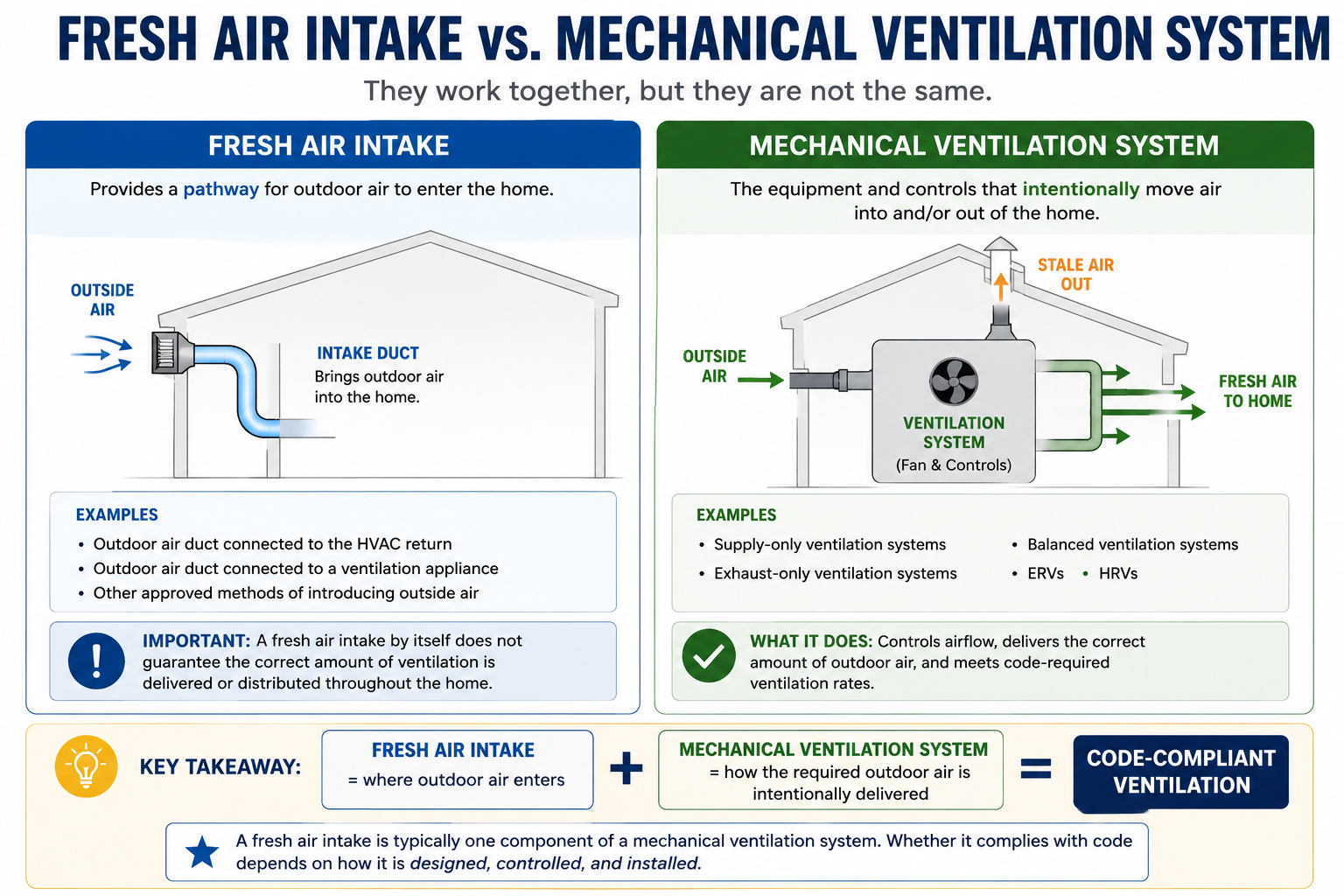
Fresh Air Intake vs. Mechanical Ventilation
2018 IECC Mechanical Ventilation Requirements
Section R403.6 — Mechanical Ventilation
The 2018 IECC requires the building to be provided with ventilation that meets the applicable requirements of the International Residential Code or International Mechanical Code.
The section also requires outdoor-air intakes and exhausts to have automatic or gravity dampers that close when the ventilation system is not operating.
What This Means
The 2018 IECC requires an approved mechanical ventilation system, but it does not contain the same specific whole-house ventilation airflow testing requirement found in the 2021 and 2024 editions.
The ventilation system must still be properly designed and installed under the applicable IRC or IMC provisions. A jurisdiction may also adopt a local amendment requiring airflow testing, commissioning, or a specific ventilation form.
Under the unamended 2018 IECC:
Mechanical ventilation is required as applicable.
The system must comply with the adopted IRC or IMC.
Whole-house ventilation fan efficiency requirements apply.
Mechanical ventilation airflow testing is not expressly required by the IECC.
Local amendments may add testing or documentation requirements.
2021 IECC Mechanical Ventilation Requirements
Section R403.6 — Mechanical Ventilation
The 2021 IECC requires buildings and dwelling units to be provided with mechanical ventilation that complies with the applicable residential or mechanical code requirements.
Section R403.6.3 — Testing
The 2021 IECC requires mechanical ventilation systems to be tested and verified to provide the minimum ventilation airflow required by Section R403.6.
Testing may be performed in accordance with the ventilation equipment manufacturer's instructions or by using an approved airflow-measuring device at the system's terminals, grilles, fan openings, or connected ducts.
A written report of the testing results must be signed by the party performing the test and provided to the code official.
What This Means
Unlike the 2018 IECC, the unamended 2021 IECC includes a direct requirement to test the mechanical ventilation airflow.
It is not enough to confirm that a fresh-air duct, controller, or ventilation appliance was installed. The completed system must be tested to verify that it delivers the required airflow.
Under the unamended 2021 IECC:
Mechanical ventilation is required as applicable.
The ventilation system must comply with the applicable IRC or IMC requirements.
The installed mechanical ventilation airflow must be tested.
The airflow must meet the minimum required ventilation rate.
The person performing the test must prepare and sign a written report.
The report must be provided to the code official.
Local amendments may modify the testing method, required documentation, or who may perform the test.
2024 IECC Mechanical Ventilation Requirements
Section R403.6 — Mechanical Ventilation
The 2024 IECC continues to require mechanical ventilation that complies with the applicable ventilation provisions of the code.
Section R403.6.3 — Testing
The 2024 IECC requires mechanical ventilation systems to be tested and verified to provide the minimum ventilation airflow required by Section R403.6.
Testing must be performed in accordance with ANSI/RESNET/ICC 380. Where required by the code official, the testing must be conducted by an approved third party.
A written report of the results must be signed by the person performing the test and provided to the code official.
What This Means
The 2024 IECC continues the airflow-verification requirement introduced in the 2021 edition but provides a more specific testing standard.
The significant change is that the 2024 edition directs the tester to ANSI/RESNET/ICC 380 rather than relying only on manufacturer instructions or generally accepted airflow-measuring methods.
Under the unamended 2024 IECC:
Mechanical ventilation is required as applicable.
The ventilation system must be tested.
Testing must verify that the system delivers the required minimum airflow.
Testing must follow ANSI/RESNET/ICC 380.
The code official may require testing by an approved third party.
A signed written report must be provided to the code official.
Local amendments may modify administrative or enforcement requirements.
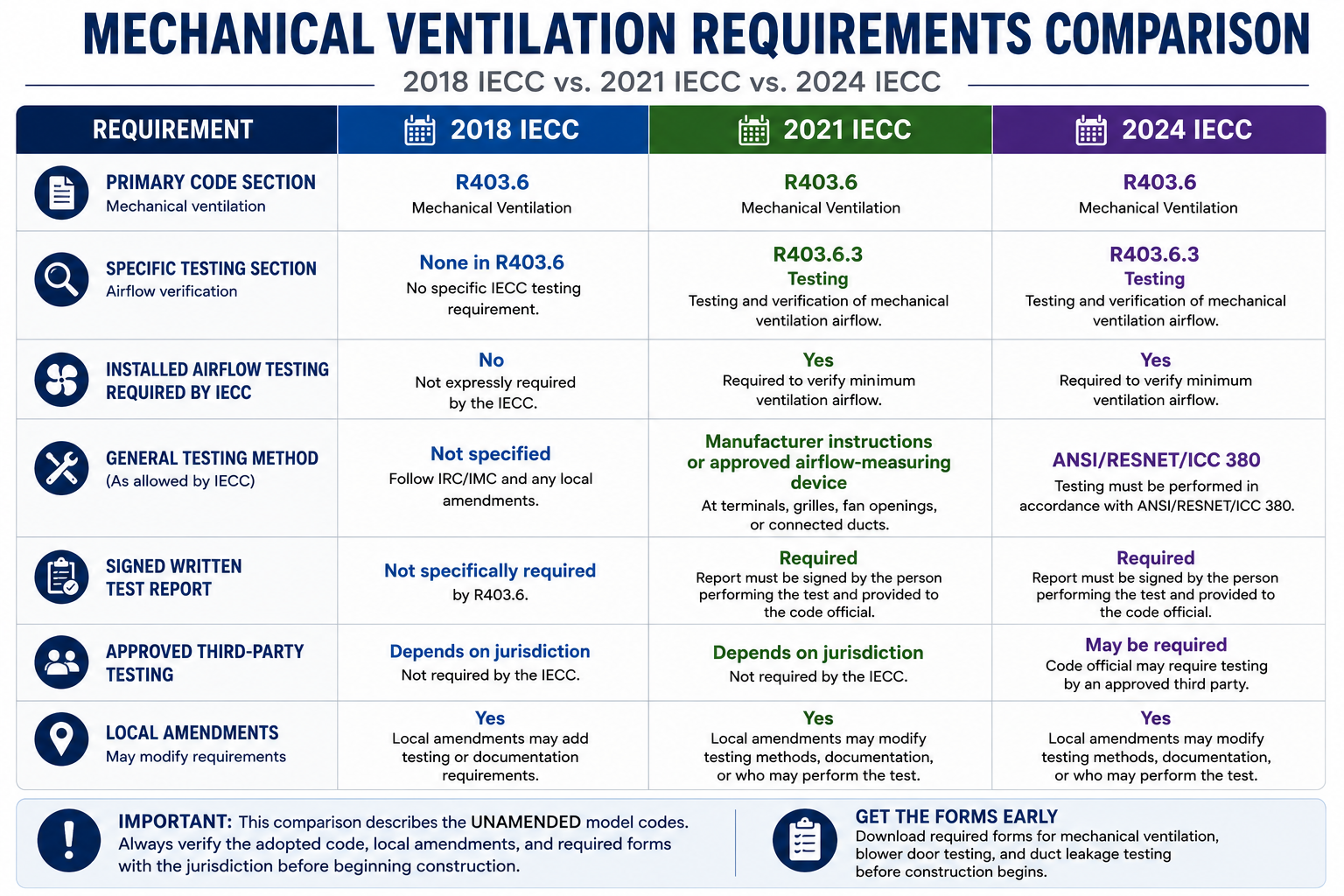
2018 vs. 2021 vs. 2024 Mechanical Ventilation Comparison
Important: Always verify the adopted code, local amendments, and required documentation with the jurisdiction before beginning construction.
Where Do I Find the Requirements?
Every jurisdiction has the authority to adopt different code editions and amend those codes.
Before beginning construction, verify the following:
1. Adopted Energy Code
Determine whether the jurisdiction has adopted the 2018, 2021, or 2024 IECC.
2. Local Amendments
Review the city's adopted amendments to determine whether ventilation requirements have been modified.
3. Required Forms
Many jurisdictions publish forms for:
Mechanical ventilation
Blower door testing
Duct leakage testing
Energy compliance
Download these forms before construction begins so they are available throughout the project.
4. Building Department Resources
Most jurisdictions publish this information under their Building Inspections or Development Services webpage.
Builder Tip
During the planning phase of every project, ask these four questions before construction begins:
✔ Which IECC edition has this jurisdiction adopted?
✔ Has the city amended the mechanical ventilation requirements?
✔ Will mechanical ventilation testing be required?
✔ What forms and documentation must be submitted before final inspection?
Answering these questions before construction starts can prevent costly delays and help keep your project on schedule.
De Leon Energy Takeaway
The biggest mistake we see isn't installing the ventilation system — it's assuming every city has the same requirements.
A few minutes spent verifying the adopted code, local amendments, testing requirements, and required forms before construction begins can save hours of delays during inspections.